Lippincott x PLAY
Leading art direction and interaction design for Lippincott's AI experimentation platform
ROLE
Interaction Design Intern
TIMELINE
Jul - Oct 2023
TEAM
Eric Wang, Daniel Zhu
TOOLS
Figma, Midjourney, Runway
THE PROJECT
In 2023, Lippincott wanted to go public with what they'd been doing internally — experimenting with AI across branding, consumer research, and design. PLAY was built to showcase their experiments and invited visitors to explore the technology themselves.
The challenge wasn’t simply presenting information. It was translating something inherently unpredictable and abstract into an experience that felt tangible.
MY ROLE
I led interaction design and art direction across the experience, from the landing page to the article system, and built a modular framework that allowed the site to keep publishing long after my internship ended. Rather than executing against an established direction, I was expected to define how the experience should feel and function.
THE CHALLENGE
A core interaction that didn't feel like one
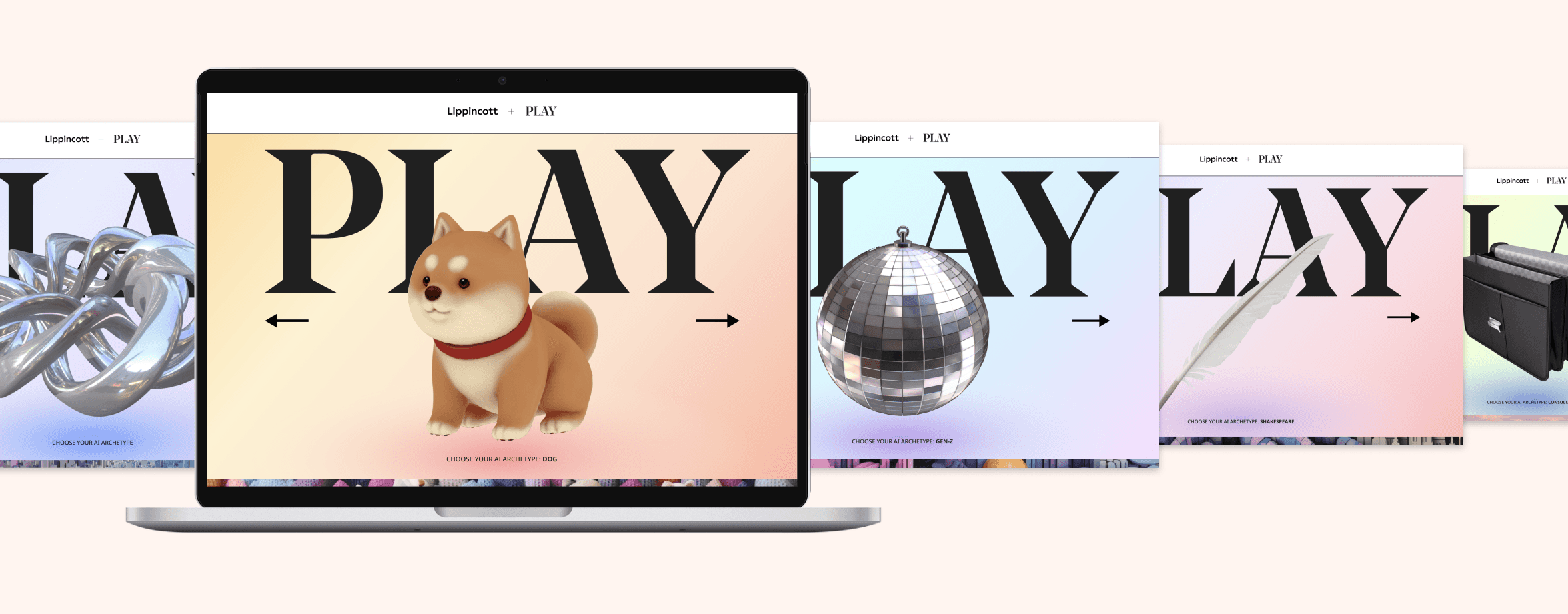
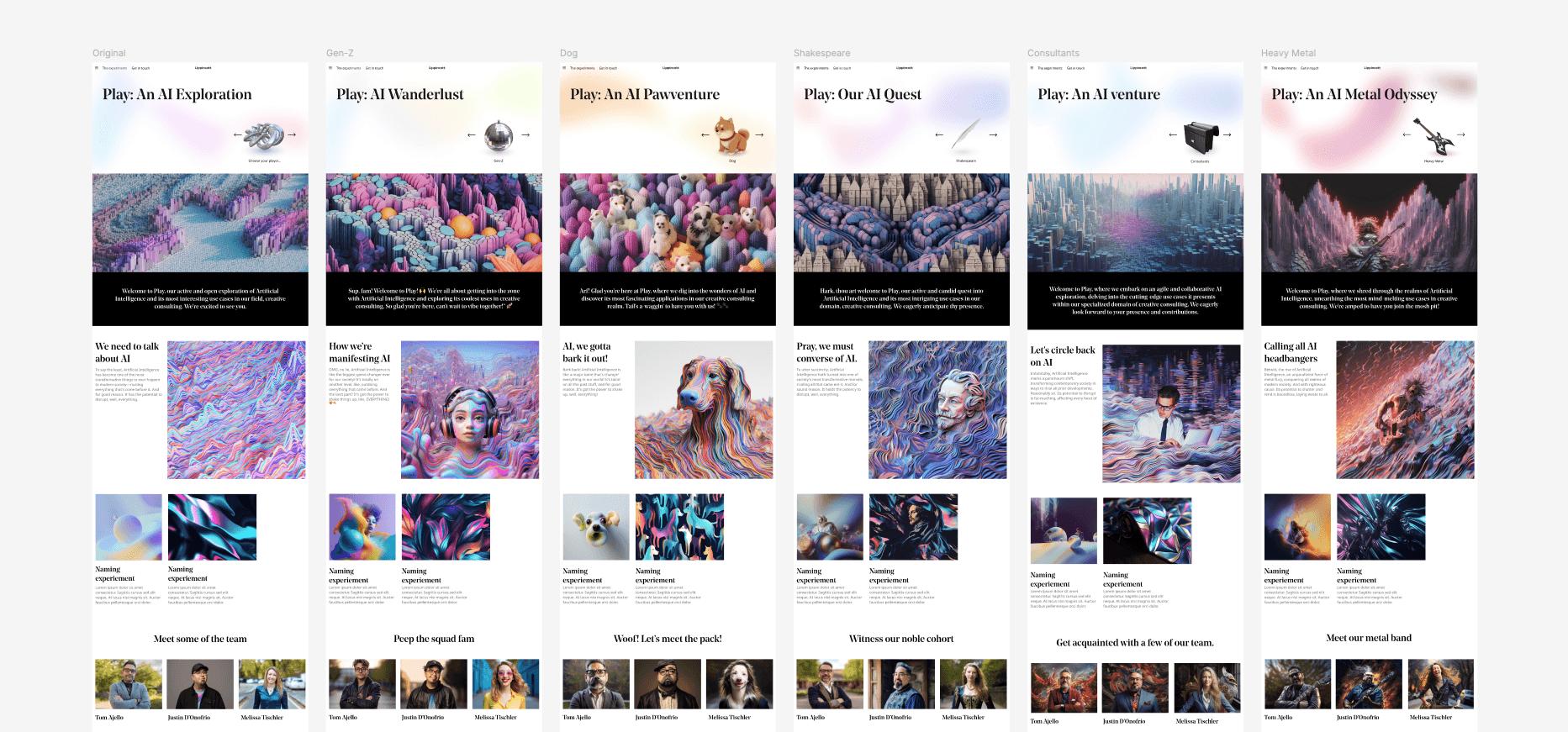
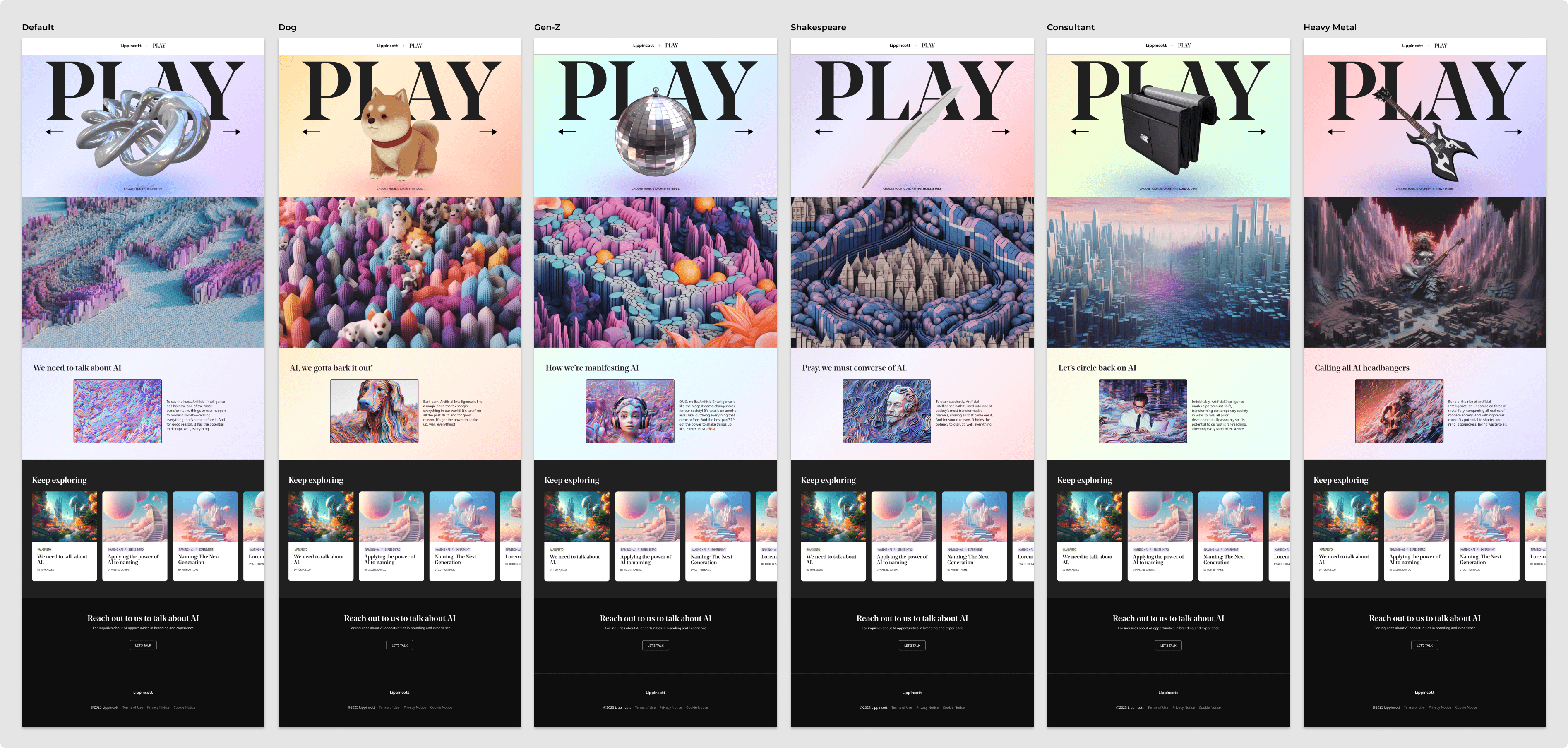
At the center of the platform was a simple but compelling idea: users could switch between six different AI-generated archetypes—“Dog,” “Gen-Z,” “Consultant,” and others—and see completely different outputs depending on the perspective.
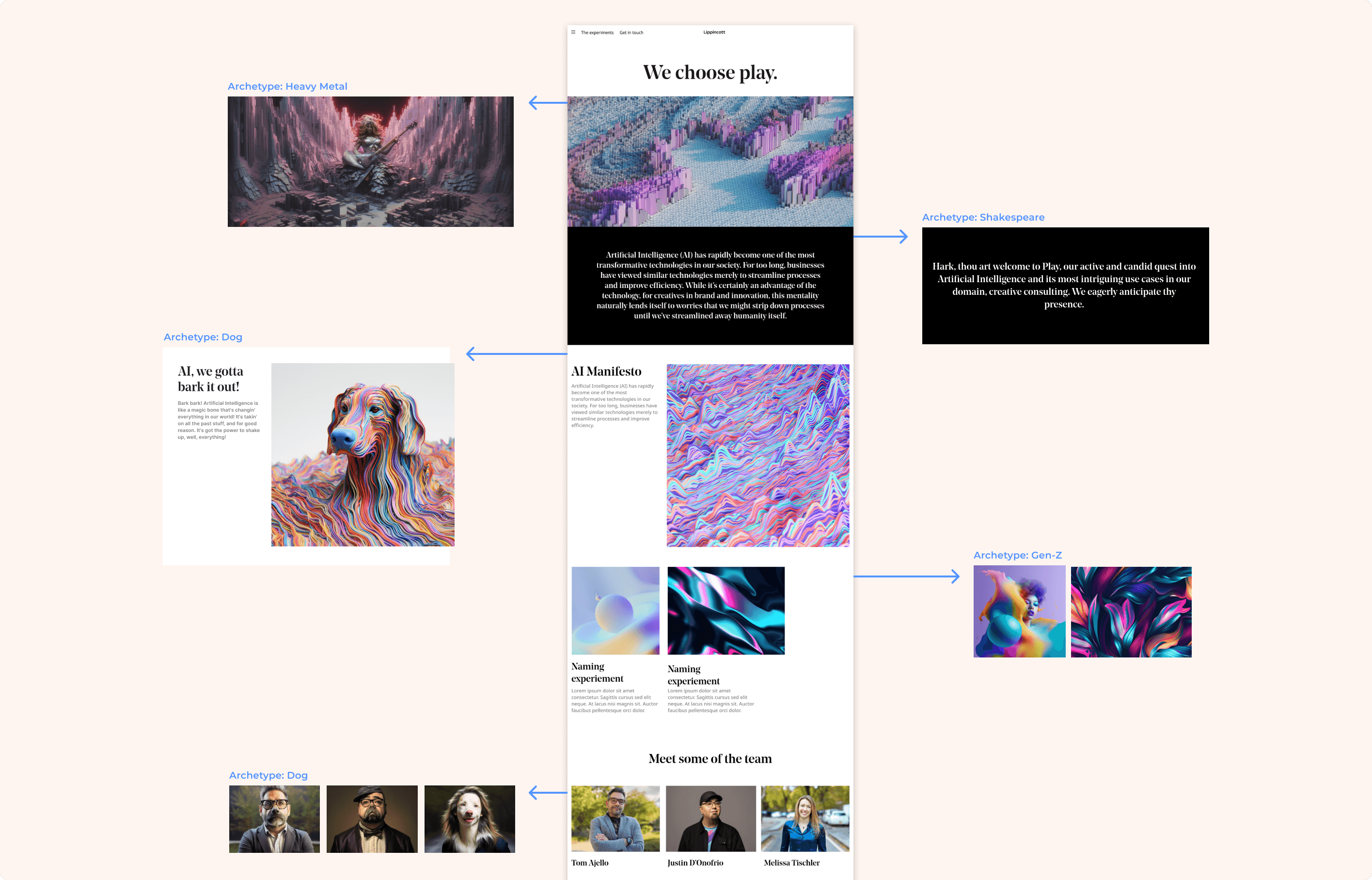
The problem was that the initial implementation treated this as a purely functional toggle. Each archetype lived in a separate WordPress template, and switching between them had no real transition.
Functionally it worked. Experientially, it undercut the whole point: if the most interesting thing is that it produces wildly different output for different personas, that moment of switching needs to feel like something.
Articles that needed to become experiences
The second challenge came from the content itself. The articles (covering experiments in naming, research, and design) arrived as long-form documents. They were thoughtful and well-written, but if translated directly into a standard blog layout, they would have flattened the experience.
There was a disconnect between the message and the medium. The design needed to do more; to build immersive digital spaces where text, visuals, and interactions felt like something you could almost touch, not just read about.
Designing for scale
The final constraint was less visible but more important. The site was meant to continue evolving with new articles and contributors coming in over time.
Without a system in place, every new piece of content would require design involvement, and consistency would start to break almost immediately. I needed to design something that not only looked good, but could keep working after I was no longer there.
DESIGN DECISIONS
Making the toggle feel like the point
I went through a lot of directions — standard dropdowns, emoji selectors, button groups — before landing on something that actually worked.
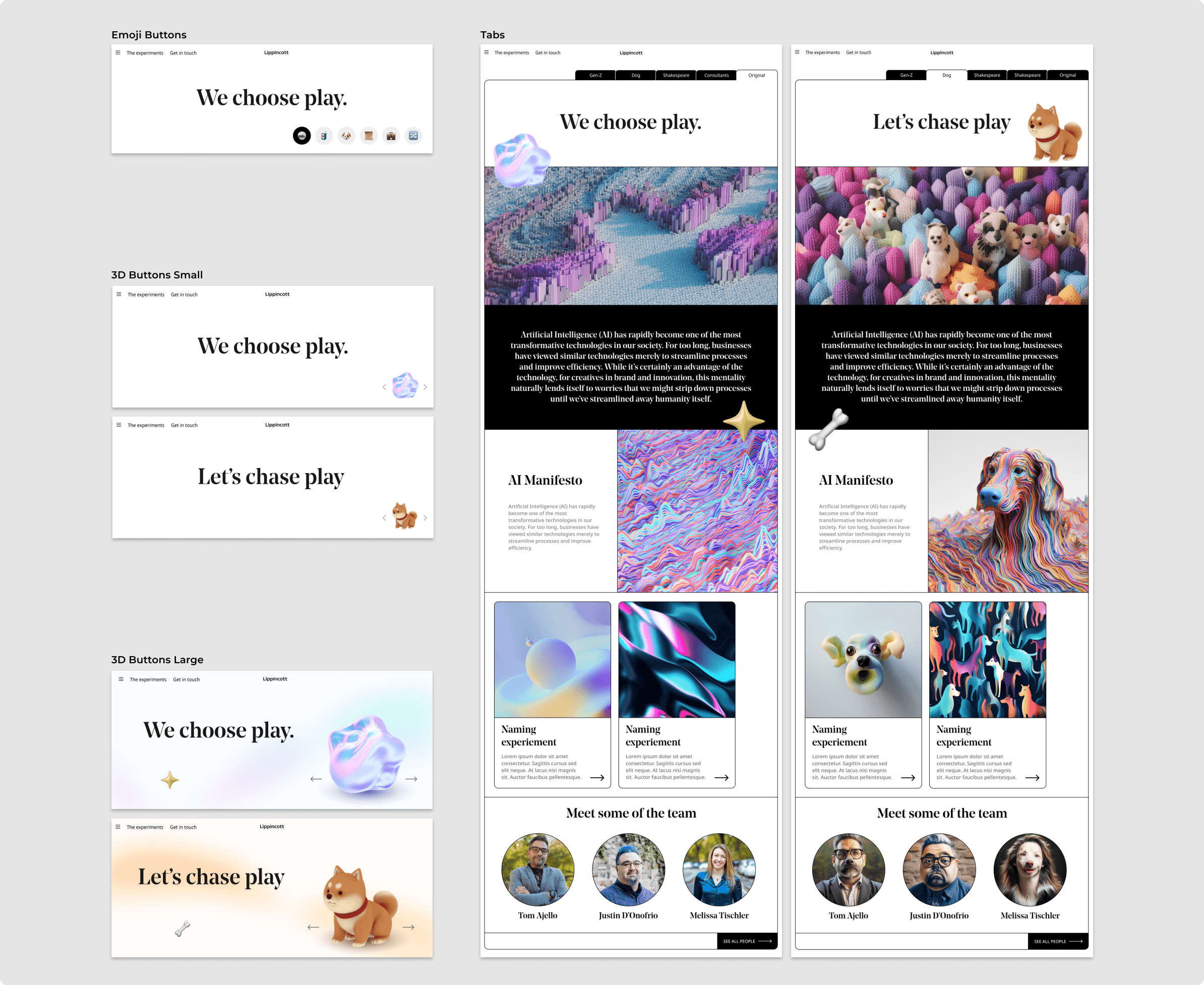
The breakthrough was treating each archetype as a character rather than an option. The final design used 3D model representations paired with gradient transitions and scroll-triggered animation, so switching personas felt like stepping into a different world rather than applying a filter.
A module system built to last
With multiple articles, multiple series, and multiple contributors all moving at once, designing each piece individually wasn't an option.
I built a library of reusable interaction modules with scroll animation templates, visual containers, and text-media pairings that could be assembled into any article regardless of series. The goal wasn’t to standardize everything, but to create enough structure that new content could be assembled without starting from scratch.

Breaking text out of the frame
To support the idea of AI as something fluid and evolving, I moved away from conventional content layouts. Instead of placing text inside rigid containers, I let it move more freely across the page—layered over full-bleed visuals, revealed gradually through scrolling, and paired directly with the outputs it was describing.
In some cases, the experiments themselves were embedded into the articles, so readers could interact with them instead of just reading about them. The experience started to feel closer to a walkthrough or a gallery than a traditional article, which aligned more closely with the intent of the platform.
Handoff documentation
Because so much of the experience depended on motion and generative visuals, the handoff process needed to be more detailed than usual. Rather than relying on static mocks, I documented how interactions should behave over time, how modules could be reused, and how new visuals could be generated while staying consistent with the overall system.
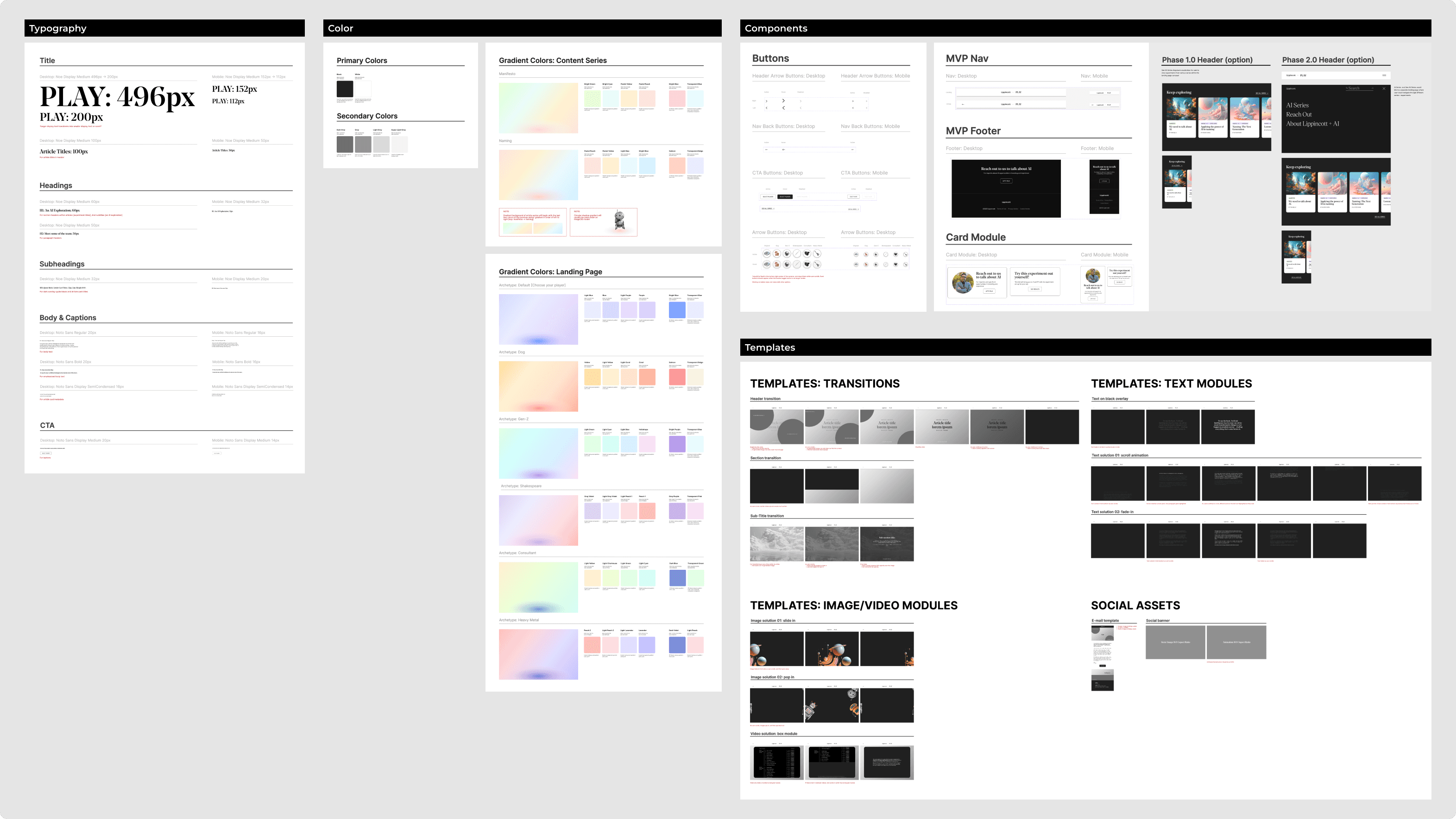
This included interaction specs, animation breakdowns, and guidelines for using tools like Midjourney and Runway. The intention was to make the system understandable and usable without needing ongoing design input.
OUTCOME
The platform launched as a client-facing way for Lippincott to share their AI work, but more importantly, it became something the team could continue building on. The modular system made it possible to publish new content without redesigning each piece, and the experience remained consistent as it evolved.
The site is still live today, which makes it easy to see how those decisions played out over time. More than anything, it reflects the value of designing for continuation, not just launch.
REFELCTION
This project changed how I think about design. It pushed me to think beyond static screens and focus more on interactions, systems, how things scale, and how they continue functioning without constant input.
Over the course of the project, the brief evolved a lot, and while that kind of ambiguity is normal for early stage creative work, the joy of exploring new directions and playing around with immersive digital experiences really re-emphasized why I’m in this field in the first place.
OTHER WORKS